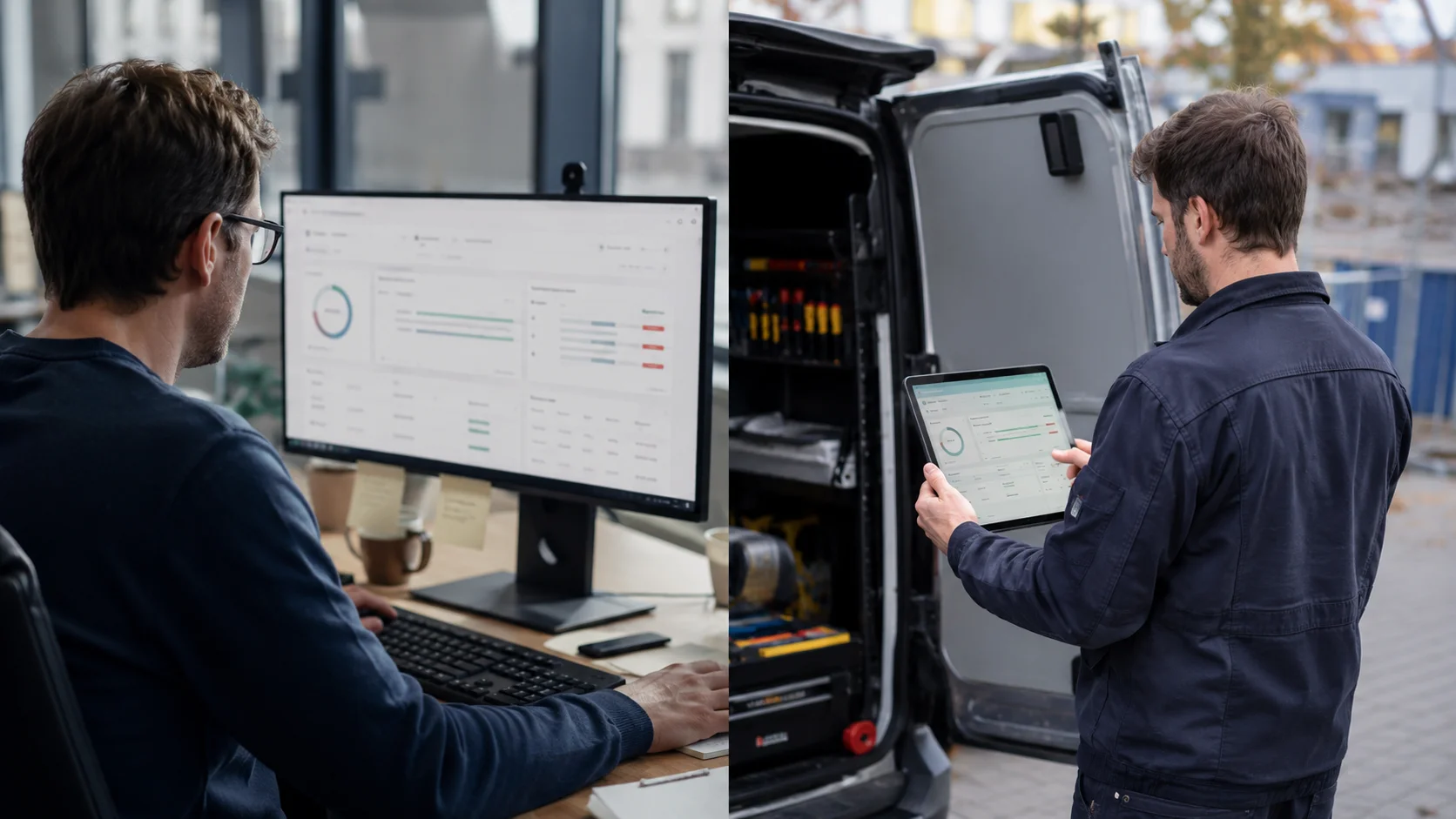

In many companies, the office and the field work on exactly the same customers, quotes and projects, but from different sources. The office looks in the ERP and the mailbox, the engineer in an app, a folder or a chat group. Everyone has a piece of the truth, nobody has the whole. The result is calling, chasing and re-typing.
~1 day a week
According to McKinsey, knowledge workers spend around 1.8 hours a day, roughly a day of the working week, searching for and gathering information. A large part of that is pure coordination between people looking at different sources.
Why separate sources cost so much
Every time information is moved from one place to another, noise creeps in: an hour estimated by feel, an address change that lands in only one system, an agreement left hanging in a chat message. Not because people are careless, but because the information comes together nowhere automatically. The more sources, the more handovers, and every handover is a chance for an error.
What 'one source of truth' really means
One source of truth doesn't mean 'yet another system', but that there is exactly one place where a piece of data lives. A customer, a project, a serial number or a service history exists once, and everyone, at the office and in the field, looks at that same current version. If the engineer changes something, the office sees it immediately, and vice versa. No copies, no versions, no 'which list is right now'.
Simplicity for the field, control at the office
Sharing the same source doesn't mean office and field need the same screen. An engineer wants a simple view: which job, which installation, which service notes. The office wants full control: quotes, planning, margins and history. One source with two views gives both exactly what they need, without the data drifting apart.
This is the starting point of Ralect One: one environment where contacts, quotes, projects and service are linked, with one chat and activity log per record. The field sees a simple view, the office keeps full control, and both work from the same source. Your financial administration stays in your accounting package; the operation around it runs in one place.
The result is not only fewer errors, but above all less coordination. The question 'how is this project doing?' is already answered on the screen, whether you're at the office or in the van. The time that frees up goes to customers and craftsmanship instead of to figuring things out.